
If you’re getting a Class 1, 3, or 4 licence in Alberta and the vehicle has air brakes, you need the Q endorsement first — and that means passing a 30-question knowledge test plus a hands-on inspection. Most people don’t fail because the material is hard. They fail because nobody tells them what’s actually on the test until they’re sitting in front of it. Here’s the full breakdown: the exact test format, the 7-step check examiners look for, ten practice questions to run through beforehand, and what an air brakes course in Calgary costs to book.
Who Needs the Air Brake Q Endorsement
Alberta requires the Air brake Q Endorsement for anyone holding a Class 1, 2, 3, 4, or 5 licence who plans to drive a vehicle equipped with air brakes — this covers most tractor-trailers, straight trucks, and buses. There’s one narrow exception: single-motor farm vehicles don’t need it, though farm vehicle combinations that require a Class 1 licence still do. If you’re already booked into a Class 1 or Class 3 program, the air brake component is usually built in — check with your school before registering separately.
What’s Actually On the Air Brake Test
The Air Brake Q endorsement has two parts, and Alberta is specific about the format of both. Here’s what the province publishes:
| Knowledge test format | 30 multiple choice questions, electronic, English only |
| Pass mark | 25 of 30 correct (about 83%) |
| Auto-fail rule | The test ends immediately if you get 6 questions wrong |
| Time limit | None — and no limit on how many times you can retake it |
| Classroom minimum | 6.5 hours of instruction at a licensed driver training school |
| Practical component | 15-minute instructor demo, two practice run-throughs, then a one-on-one assessment |
| Practical retakes | One re-assessment allowed before you’re required to take more training |
That auto-fail rule catches people off guard — the system doesn’t wait until question 30 to tell you you’ve failed. If you miss 6, it stops. That’s exactly why guessing your way through is a bad strategy: you need to actually know the material, not just recognize it.
7-Step Air Brake Pre-Trip Check
Most of the practical assessment — and a good chunk of the knowledge test — comes back to one thing: the pre-trip air brake inspection. Examiners walk through it in roughly this order:
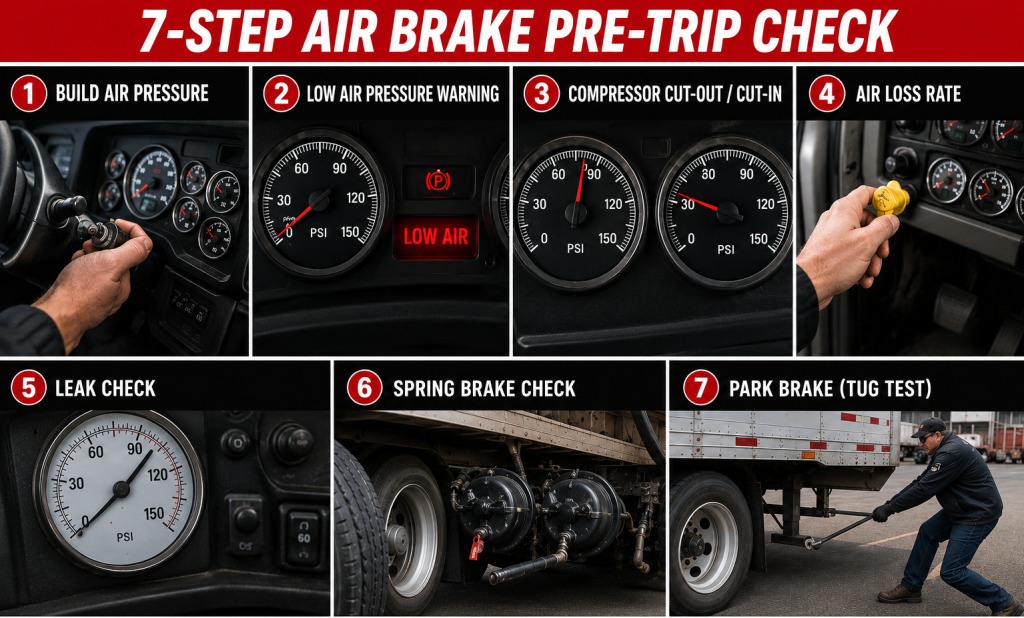
- Engine off, park brake released — check that air pressure builds normally as the engine runs.
- Check the low air pressure warning — it should trigger before pressure drops below about 60 psi.
- Test the air compressor cut-out and cut-in pressure by running the engine and watching the gauge.
- With the engine off and park brake released, pump the brakes and confirm air loss rate is within limit.
- Apply the brakes and hold — check for leaks at the gauge over one minute (applied and unapplied).
- Confirm spring brakes activate automatically once air pressure drops to the safety threshold.
- Do a final tug test — try to move the vehicle with the park brake set to confirm it actually holds.
You don’t need to memorize this word for word, but you do need to understand why each step exists — examiners ask follow-up questions like “what would happen if this failed,” not just “what’s next.”
How to Prepare (Without Wasting a Week On It)
Three things actually move the needle:
- Learn the numbers, not just the concepts. Cut-in/cut-out pressure, the 60 psi warning threshold, the 25-of-30 pass mark, these show up as direct questions.
- Do the pre-trip check out loud, physically, more than once. Reciting it from memory in a classroom is different from doing it with your hands on a real system.
- Take a real practice test under the same conditions — no notes, no pausing, timed pressure optional but recommended.
Air Brake Q endorsement Test Practice Questions
These cover the same territory as the real test — dual systems, warning thresholds, spring brakes, and inspection logic.
Q1. What warns the driver that air pressure has dropped too low? A low air pressure warning light and buzzer, which must activate before pressure drops below roughly 60 psi.
Q2. What happens to the spring brakes if air pressure drops to a critically low level? They apply automatically the mechanical spring, no longer held back by air pressure, sets the brake without driver input.
Q3. Why do commercial vehicles use dual air brake systems? So a leak or failure in one circuit (primary or secondary) doesn’t leave the vehicle with no brakes at all.
Q4. During a static leak test, how much pressure drop is acceptable over one minute for a single vehicle? Generally no more than about 2 psi for a single vehicle with the brakes applied — check your specific test’s published limit, as it varies by configuration.
Q5. What does the air compressor’s “cut-in” pressure refer to? The pressure point at which the compressor starts building air again after it’s dropped from the cut-out (maximum) point.
Q6. What’s the purpose of the tug test at the end of a pre-trip inspection? To physically confirm the parking brake is holding by trying to move the vehicle against it in low gear.
Q7. Why is it important to check air pressure with the brakes both applied and released? Because a leak can appear in only one state — checking both catches problems a single test would miss.
Q8. How many wrong answers cause the Alberta knowledge test to end automatically? 6 incorrect answers ends the test immediately, regardless of how many questions remain.
Q9. What’s the minimum classroom instruction required before taking the Q endorsement test in Alberta? 6.5 hours at a licensed driver training school, though many programs — including Wild Rose Academy’s — include more.
Common Reasons People Fail
Two patterns show up more than any other. First, treating the pre-trip check as something to memorize the night before instead of practicing hands-on — the practical assessment exposes that gap immediately. Second, not knowing the specific numbers (the 60 psi warning point, the 25-of-30 pass mark, the leak-rate limits) and trying to reason through questions that are really just recall. The writ
ten test rewards knowing the exact figures, not general understanding.
Cost & How to Book a Training Course
Training in Calgary: Wild Rose Academy’s Air Brake (Q) Endorsement course covers the full 6.5-hour classroom minimum plus hands-on practice on tractor-trailer units, and preps you for both the written and practical exam. See the course details and book a spot.
Alberta charges a government fee plus a service charge for the knowledge test itself, on top of whatever your training provider charges for classroom and practical instruction — training costs vary by school, so confirm current pricing directly. The knowledge test is booked through Alberta registry agents once your training is complete; the practical assessment is arranged through your driver training school.