
I get this call probably twice a week. Somebody’s been running a gravel truck or a water truck for years, they’ve decided it’s time to go Class 1, and they want to know how much of the course they can skip. Fair question. The answer is “most of it,” but the rules changed underneath everybody in 2025 and a lot of drivers are still working off old information.
Here’s what it actually looks like now.
Forget the 113 hours
That was MELT. Alberta killed it April 1st, 2025.
I still hear the number constantly. It’s in old forum threads, it’s on a couple of school websites that nobody’s touched since 2023, and it comes up in half the phone calls I take. Doesn’t apply anymore. If you want the side by side, we broke it down in Class 1 Learning Pathway vs Class 1 MELT Program.
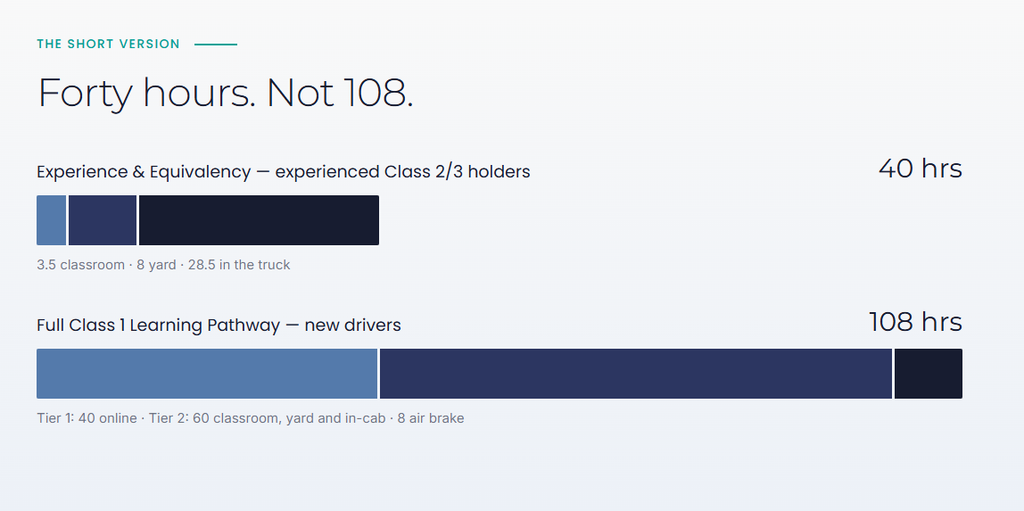
What replaced it is the Class 1 Learning Pathway, which runs in four tiers. Guy off the street with a Class 5 and nothing else does Tier 1 (40 hours, all online) and then Tier 2 (60 hours of classroom, yard and in-cab, plus 8 more for air brake if he hasn’t got his Q). So 108 hours before he can book a road test.
That’s not you though.
You qualify for the short version. Probably.
It’s called Experience and Equivalency and there are two gates.
Gate one, you hold a valid Alberta Class 2 or Class 3.
Gate two, and this is the one that bites people, you’ve got two years of real experience on something with three or more axles. Two years of driving it. Not two years of the licence sitting in your wallet while you drove something else. Alberta Transportation actually checks this.
I’ve had guys walk in genuinely convinced they qualified, and then it turns out most of their Class 3 time was on a two axle straight truck. That’s a bad conversation to have after you’ve already given notice at work.
So go find your records. T4s, dispatch printouts, a letter from your old dispatcher, whatever exists. Before you do anything else.
You also need a full Class 5 and not a GDL, and you need to be 18. I’ve never once seen either of those be the problem, but they’re on the list.
What the 40 hours consist of
3.5 classroom, 8 in the yard, 28.5 in the truck.
Classroom’s short because there’s no point teaching you hours of service again. Or load securement. Or how to do a pre-trip at 5am in January. You’ve been doing that for years.
Almost everything goes into seat time, and I'll tell you exactly why.
Backing.
That’s it, that’s the whole answer. Eight out of ten Class 3 drivers who come through here drive beautifully down the road and then completely come apart in the yard around day three. Alley dock, blind side, offset. Your hands already know how to reverse a straight truck, and right now that’s a liability, because the trailer pivots and you correct the wrong direction on instinct. Watching a ten year veteran get frustrated with a set of cones is a regular Tuesday for me.
Offtracking is the other adjustment. You’ve read your mirrors for a rigid unit for a decade and now your back end cuts inside the turn. Some drivers sort it out in an afternoon. Others take most of a week and there’s no predicting which you’ll be. Anyway, That’s what the 28.5 hours are for.
Air brakes
Skip this if you’ve got your Q already, which a lot of Class 3 holders do.
If not: 6.5 hours minimum of classroom at a licensed school, then practical work where you’re actually doing the pre-trip yourself, not watching.
Written’s 30 questions, pass mark is 25. No time limit, retake it as often as you need. Nobody’s ever been stopped permanently by that test, and if you want to warm up first we’ve got practice questions for the Alberta air brake test here.
The practical’s the serious one. Fifteen minutes, one on one, and you get one reassessment. After that they send you back for more training.
The three things standing between you and the licence
Medical, written, road test. In that order, and I’d start the medical yesterday.
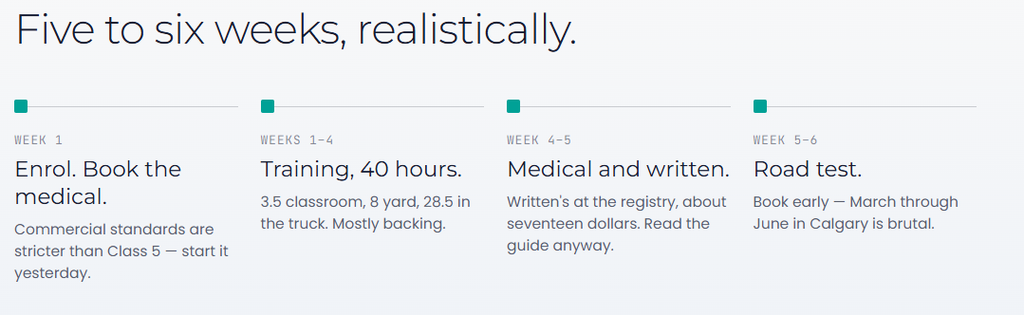
Commercial medical standards are stricter than Class 5 and you need the Driver’s Medical Report completed before they’ll issue you anything. If you’ve got sleep apnea, or diabetes, or any cardiac history, you may end up waiting on a specialist. I’ve watched that add six weeks to somebody’s timeline. Book it the same week you enrol.
Written test’s at the registry, about seventeen dollars. You’ll know most of it. Read the Commercial Driver’s Guide anyway. The combination vehicle weight rules trip up experienced guys more than they trip up rookies, because rookies actually study.
Road test goes through the Alberta Road Test Scheduler, or a registry agent can book it. Availability in Calgary is seasonal. March through June is brutal, everybody has the same idea at the same time. Our guide to Alberta road test prep covers what the examiner is actually watching for.
The restriction
Okay, pay attention to this bit, because it’s the thing nobody mentions until it’s too late.
Pass your road test through Experience and Equivalency and the licence you get has an Alberta only restriction on it.
Provincial. You’re licensed, you can work, you get paid. You just can’t cross into B.C. or Sask. If you’re staying local that’s completely fine and plenty of drivers never bother going further. If long haul was the plan, it’s a problem, and the way most guys find out is sitting in an interview.
To clear it you do the Competence Building Program. 3 hours yard, 14 to 22 hours one on one in the truck, so 17 to 25 total. Depends how your road test went. Cleaner test, fewer hours, less money. Province wants it done inside a year of your core training.
Honestly? Just do it while you’re already in the seat. I say that as somebody who’d make money either way. Drivers tell me they’ll never leave Alberta and then a linehaul job posts and suddenly they’re calling me back, and now they’re booking time off work all over again to do 20 hours of training they could’ve knocked out in the first place.
What it costs
You’ll see $10,000 to $12,000 floating around. That’s the province’s fee cap on the full new driver Pathway as of April 2026. Not what you’re doing.
Experience and Equivalency at most Alberta schools is low to mid four figures. Competence Building’s billed separately, usually a couple grand. Air brake on top if you need it, plus the road test permit and truck rental for the test.
Ask for it itemized in writing before you hand over a deposit. “Course fee” means something different at every school and that’s where the surprises happen.
Phone around. There’s more spread in the pricing than you’d think. And before you assume you’re paying the whole thing yourself, have a look at what grants and funding support you might qualify for.
Timeline
Three or four weeks of training if you can go full time. Then a week or two for the medical, the written and getting a road test date. Realistically five to six weeks.
Training around shifts drags it out. Ask about evenings and weekends before you sign anything.
Is it worth it
Mostly, yeah. Not because your hourly doubles, it won’t. Because of what you can bid on. Long haul, LTL linehaul, oilfield, Super B, the camp work that pays your travel. Class 3 work rides the construction cycle and you already know how that feels in November. We went through the pay and lifestyle differences properly in Class 1 vs Class 3 Truck License.
But I’ll give you the other side, even though I run a driving school. If you’re home every night and you like who you work for and the money’s alright, a Class 1 doesn’t automatically improve your life. It gives you more options. Whether any of them are better than what you’ve got is your call, not mine.
Start here
Prove the two years first. Everything else depends on it. Forty hours or 108 is a completely different budget and a completely different conversation.
We run Experience and Equivalency out of Calgary, plus air brake and the Competence Building training that gets the provincial restriction off. If you’re not sure which stream you’re in, call 1-403-979-0006 and we’ll go through your history with you before you commit to anything.
Requirements and fees are set by Alberta Transportation and they do get updated, so double check alberta.ca before you enrol.